A question of this kind arises in nearly every project.
Whether you should display your prices on your website or ask people to contact you for a quote.
There isn’t a single correct answer, but there is the appropriate answer for your business. The choice will influence how people see your brand, how they interact with your site, and the likelihood that they will get in touch.
Below is a clear examination of the advantages and disadvantages, along with how we usually handle it.
Why Showing Prices Often Works
In many businesses, displaying prices improves the overall experience.
The main reason is transparency. If visitors can easily see how much something costs, this eliminates uncertainty and establishes trust immediately. They don’t have to guess, and there’s no need to start a conversation to get simple information.
It also helps in defining your target audience; if a person is outside the appropriate budget range, they will probably leave the process early. Although that may seem like a disadvantage, it saves time for both parties since you spend less time dealing with inquiries that aren’t suitable, and serious prospects go ahead with greater confidence.
There is also a momentum factor: when prices are clear, visitors can move through the decision process more quickly; rather than stopping to ask questions, they can evaluate, compare, and then take the next step.
In certain situations, this approach can even make you stand out; since a great many businesses choose not to display their prices, being clear about them can come across as a refreshing change to potential customers.
Where Showing Prices Can Create Challenges
Nevertheless, there are good reasons why certain businesses decide not to show their prices.
A problem is that it might drive away visitors who are sensitive to price too soon. People could leave without giving your business a fair chance if they see a figure before they’ve understood the value it represents.
This point is particularly important when it comes to services which involve context. Where the service you provide depends on the scope, the level of complexity, or the degree of customization, a one-off price can be misleading. It might undervalue the work or put people off before they know what is included.
A further limitation concerns flexibility. If prices are made public, it may become more difficult to adjust them according to different circumstances. This might involve providing custom packages, reacting to changes in the market, or adjusting the pricing to meet the particular needs of clients.
For certain businesses, particularly those offering highly customized services, it is possible not to display prices on the website to gain greater control over the sales process.
A More Practical Approach
In most cases, the decision in question is not an absolute one.
You needn’t decide whether to display full prices or to hide them entirely; there is a reasonable compromise that suits a great many businesses.
That might look like:
- Starting prices or price ranges
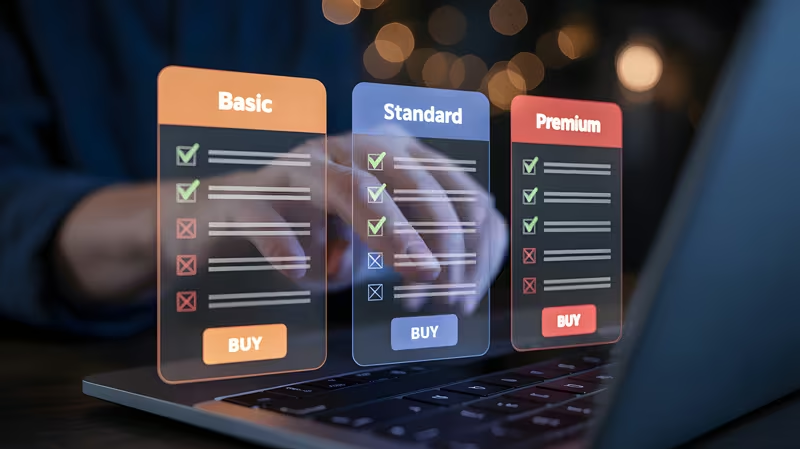
- Package tiers with clear inclusions
- Example projects with estimated costs
This method enables visitors to get an idea of what to expect without committing you to strict pricing; it ensures transparency while also permitting flexibility.
What We Recommend
Generally, we prefer to display some pricing on the website.
The advantages of transparency, trust, and better-qualified leads generally make up for the disadvantages. Since a prospect contacts you after having seen your prices, they already have a basic idea of what to expect. This in turn results in more effective conversations and a more seamless sales process.
In other words, the appropriate method will vary according to the type of business you have.
In most cases, it is best to state clear prices when your services are standardized and easy to define; whereas with highly customized work, a combined approach using starting prices or price ranges might be more appropriate.
What’s important is that all the elements are aligned. Your pricing strategy must match your brand, your audience, and the way you would like clients to engage with your business.
Final Thoughts
Your website is not merely a place where you can display your services; it is a tool that influences the way people interact with your business.
Displaying the prices can reduce friction, establish trust, and enable the appropriate clients to move forward more quickly. Holding prices back, on the other hand, gives you greater flexibility and control over the sales process.
Neither method is objectively correct or incorrect; choose the one that benefits your business and provides the best experience for your audience.
When in doubt, lean toward clarity. The easier you make things for your visitors, the more likely they are to take the next step.